

PR in the Age of AI: How Brands Can Build Trust When Anyone Can Generate Content
A few years ago, producing a well written article, press note, or thought leadership piece took real time, research, and writing skill. Today, anyone with an internet connection can generate a polished blog post, a social caption, or a convincing looking news story in seconds.
Artificial intelligence has lowered the barrier to content creation dramatically, and while that has made communication faster and more accessible, it has also created a harder problem for brands: trust is getting more difficult to earn. When audiences are surrounded by AI Generated Content, polished writing on its own stops being enough to make a brand credible. People want to know who is actually behind the message, whether the information holds up, and whether there’s real expertise or evidence behind the claims.
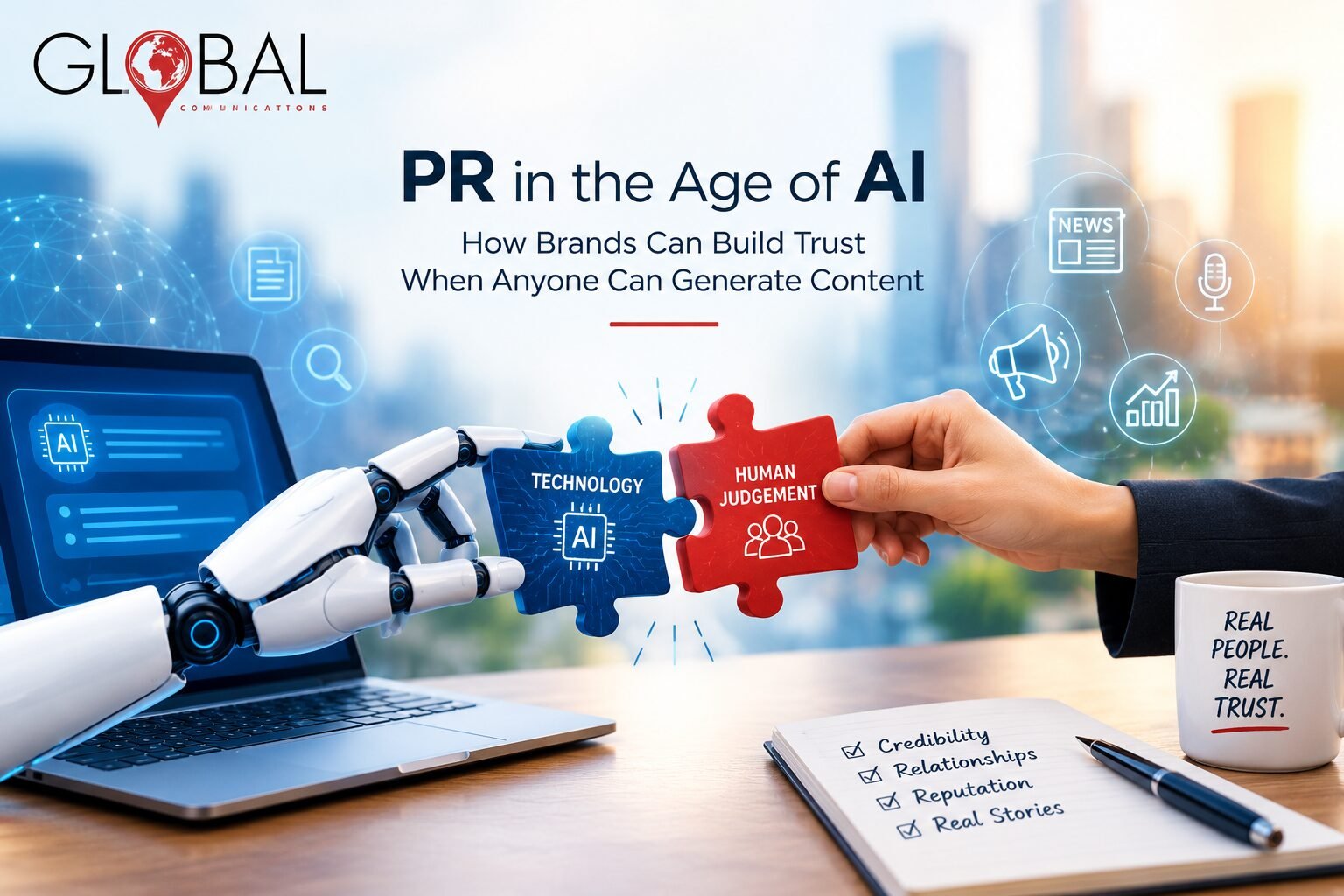
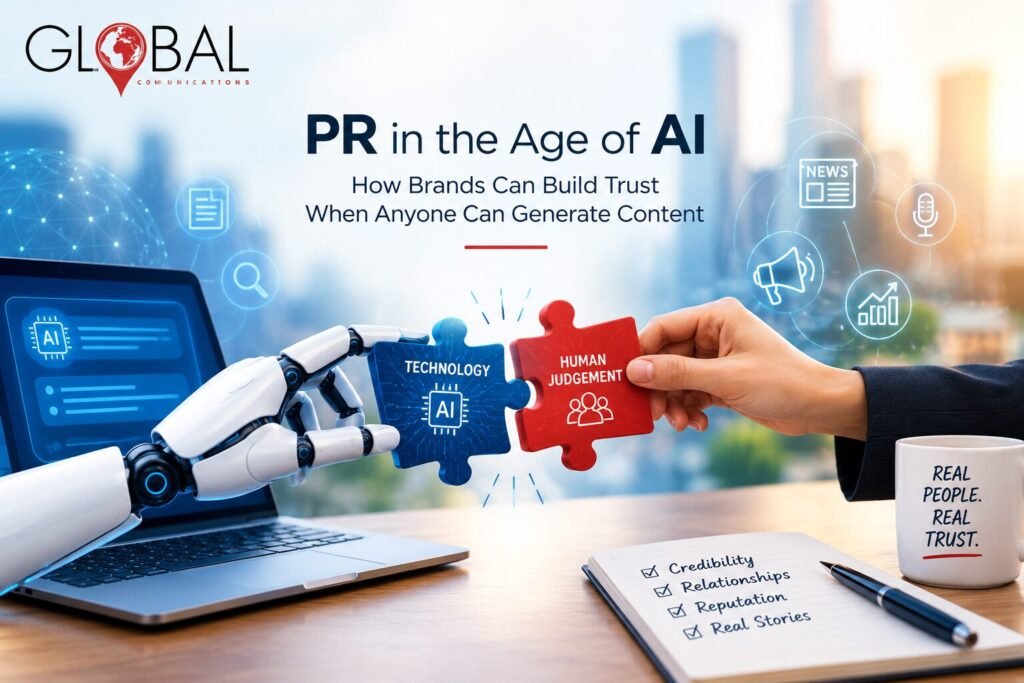
That is changing the role of Public Relations. The fundamentals haven’t moved: building relationships, protecting reputation, earning media attention, and creating credibility are still the job. What’s changed is how brands get there. In the age of AI, the PR that actually works is the kind that finds the right balance between technology and human judgement.
The new reality: when everyone can publish
The barrier to publishing has almost disappeared. Marketing teams can put out an article in minutes. Competitors can run a social campaign at scale. Customers can share detailed reviews and opinions the moment they have them. Even a single person can use AI tools to make content that looks professional and authoritative.
As a result, simply having more content is no longer a competitive advantage. Credibility is. A brand can publish hundreds of articles, social posts, and press releases, but if none of it carries an original insight, reliable information, or a recognisable human perspective, none of it builds lasting Brand Trust.
This is where Digital PR earns its value. Digital Public Relations isn’t just about generating online mentions. It means earning attention and credibility through journalists, publications, industry experts, communities, and other independent sources, the kind of validation self published content can’t provide on its own. When everyone can publish, being independently recognised is what actually sets a brand apart and protects its Brand Reputation over time.
AI in Public Relations: a tool, not a replacement
AI in Public Relations is already changing the everyday work of PR professionals, from research and content ideation to media monitoring and sentiment analysis, letting communication teams move faster and process information at a much larger scale. Some of the more practical applications:
Content drafting and ideation
AI in PR tools can help teams put together first drafts, press release structures, interview questions, article outlines, and social media ideas, which cuts down significantly on repetitive work. Used well, AI Content Creation speeds up the drafting stage without replacing the judgement that goes into a final piece. But the first draft shouldn’t automatically become the final one. Someone still has to verify the facts, add context, bring in an original insight, and make sure the piece actually sounds like the brand.
Media research and outreach
Finding relevant journalists and publications can be time consuming. AI powered tools can help by analysing a journalist’s beat, past articles, and audience interests, which makes the research side of media outreach more efficient. What technology can’t replace is the relationship. A journalist responds to a thoughtful, relevant pitch far more often than to a generic message blasted out to hundreds of contacts at once.
Audience research and sentiment analysis
PR teams need a read on how people are actually talking about a brand. AI can process large volumes of social conversation, reviews, and news coverage to surface common themes and shifts in sentiment, which helps teams catch an emerging concern or opportunity sooner. The technology can highlight the pattern. A person still has to work out what that pattern actually means for the brand.
Reputation monitoring
Online Reputation Management matters more in an environment where information can spread within minutes. AI powered monitoring tools can track mentions across channels and flag an unusual spike in negative conversation early enough for a team to investigate and respond before it turns into a bigger problem. AI is good at spotting the problem. Deciding how to respond to it, and protecting Brand Credibility in the process, is still a human call.
AI Marketing and AI in PR are not the same thing
Artificial Intelligence in Marketing is being adopted across almost every part of communication, but different disciplines put it to different uses. AI Marketing tends to focus on advertising, customer journeys, personalisation, lead generation, and conversions, while Public Relations is fundamentally about reputation, relationships, credibility, and public perception. AI and PR naturally overlap, but they shouldn’t be treated as interchangeable.
A brand can automate parts of its content production and marketing workflow, but genuine PR still depends on human relationships, credible information, expert voices, and recognition that’s actually earned. The point isn’t to choose between AI and human communication. It’s to use AI for efficiency while keeping the strategy and the judgement human, so that AI Brand Communication never loses the human voice behind it.
AI generated content vs authentic brand communication
There’s a real difference between content that is generated and communication that is genuinely meaningful. AI can reproduce patterns in language, organise information, and put together something that sounds professional, but it doesn’t automatically carry a founder’s personal experience, an employee’s industry knowledge, or a customer’s genuine story. That human context is exactly what matters.
Authentic brand communication can come from a founder explaining why the company made a difficult decision, an expert sharing a lesson learned over years of experience, or a customer describing how a product actually changed something for them. These are hard to fake convincingly because they’re rooted in something real. That’s why human expertise is becoming more valuable in the AI era, not less. Brands that combine AI’s efficiency with original research, expert commentary, real examples, and transparent communication tend to stand out far more than brands simply publishing large quantities of generic AI Content.
Why transparency and originality matter more than ever
As AI Generated Content becomes more common, audiences are getting better at recognising how easily it can be produced, which makes a few signals of Brand Credibility more important than they used to be.
Transparency
Brands should be clear about how AI is being used when that’s relevant to the audience, and should never present an AI generated opinion, quote, testimonial, or experience as though it came from a real person.
Originality
Repeating information that’s already sitting on hundreds of other websites adds limited value. Original research, proprietary data, expert opinions, real customer experiences, case studies, and genuinely useful analysis are what give people a reason to pay attention.
Consistency
A brand’s website, social profiles, press coverage, and interviews should all tell a consistent, truthful story. When different channels make contradictory claims, Brand Trust can disappear fast.
Accuracy
In an AI driven content environment, fact checking matters even more. AI systems can produce incorrect information, misread context, or present outdated information with total confidence, and a single inaccurate claim can undermine the credibility of an otherwise strong campaign. For brands, accuracy should be treated as a reputation issue, not just an editorial one.
Practical strategies to build and protect brand trust
A strong Public Relations Strategy in the age of AI combines technology with genuine human effort. A few practical ways brands can strengthen Brand Trust:
Invest in thought leadership by encouraging founders, executives, and subject matter experts to share real opinions and experiences through interviews, commentary, podcasts, guest articles, panels, or original research. It works best when it offers a genuine point of view rather than just promoting a product.
Prioritise earned media. Self published content is useful, but independent coverage adds a layer of credibility it can’t match on its own, so it’s worth building real relationships with relevant journalists and publications and giving them information, data, and stories that are actually useful. The goal isn’t just to get mentioned. It’s to become a source worth mentioning.
Use AI for efficiency, not blindly for authorship. Let it help with research, brainstorming, summaries, content structure, media monitoring, and first drafts, but keep a human in the loop for strategy, review, fact checking, and the final edit, so the brand benefits from the speed without losing the authenticity.
Build genuine social media conversations rather than a stream of automated content. Audiences respond to brands that reply to questions, acknowledge criticism, and take part in the conversation, not necessarily the ones posting most often.
Monitor reputation proactively, before a crisis hits. Regularly checking conversations, reviews, media coverage, and social mentions gives teams more time to catch an issue early and respond thoughtfully instead of scrambling, which is really what Online Reputation Management is meant to do.
Fact check every important claim rather than assuming AI generated information is automatically accurate. Names, statistics, dates, quotes, research findings, and product claims should all be verified before anything goes out, and the faster content gets produced, the more that verification step matters.
The role of a professional PR agency
For many businesses, managing media relationships, reputation, content, and strategic communication internally becomes difficult fast. A professional PR Agency brings the strategic experience and relationships needed to navigate this well: developing a long term PR strategy, identifying relevant media opportunities, building journalist relationships, positioning founders and executives as experts, running thought leadership campaigns, managing reputation during sensitive situations, coordinating Digital PR with content efforts, and spotting the stories that actually have news value.
This is especially true for businesses looking for Digital PR Services in Mumbai, where the media landscape spans national business publications, regional outlets, and a fast growing base of digital first journalists and creators. Working with a Digital PR Agency in Mumbai that already understands these local media relationships can shorten the path to real coverage, rather than starting cold with outreach that may not land with the right people.
A PR agency‘s value isn’t simply how much content it can produce. It’s knowing what deserves attention, who should hear it, how it should be communicated, and how it feeds into the brand’s long term reputation, judgement that only gets more important as AI makes content production easier for everyone else.
How AI search and generative search are changing PR visibility
Search is changing too. Instead of always clicking through a list of results, people increasingly get a direct summary or answer from an AI powered system. That’s driven growing interest in Generative Engine Optimization (GEO) and Answer Engine Optimization (AEO), approaches focused less on ranking for a keyword and more on becoming a source that search and AI systems actually reference when answering a question.
This is where Digital PR and earned media do real work for a brand’s AI Visibility. When a brand is consistently mentioned by reputable publications, industry sites, and credible third parties, those references feed into the brand’s broader online presence and authority. That said, brands should be careful about treating GEO or AEO as a guaranteed formula. Different search engines and AI systems retrieve, evaluate, and present information differently, and there’s no single trick that works across all of them.
The more sustainable approach is building the underlying signals of credibility: demonstrable expertise, accurate and useful information, original research, reputable third party coverage, consistent information across trusted sources, clear authorship, and real visibility for the brand and its founders. AI and Brand Reputation are closely linked here, since AI systems tend to lean on sources that already carry authority rather than ones simply optimised for keywords. This is also where the principles behind EEAT, Experience, Expertise, Authoritativeness, and Trustworthiness, become relevant to content quality more broadly. For brands, the bigger lesson is simple: strong AI Search Visibility starts with actually becoming useful and credible, not with trying to manipulate an algorithm.
Digital PR and SEO can no longer work in isolation
PR and SEO have traditionally been treated as separate functions in many organisations, but that distinction is becoming less useful. A strong PR campaign generates media coverage, brand mentions, referral traffic, and expert positioning. SEO makes sure that useful brand content is actually discoverable when people search for it. Together, the two strengthen a brand’s overall digital presence.
Founder led branding is another part of this. When founders and experts consistently share meaningful opinions, interviews, research, and commentary, they become identifiable sources of expertise rather than just names attached to a company, and that kind of visibility strengthens both traditional PR and the brand’s broader footprint online.
Common mistakes brands should avoid
AI offers real opportunities, but using it carelessly can create serious communication problems. Some of the more common mistakes:
- Publishing AI Generated Content without human review
- Failing to fact check AI generated information
- Creating fake quotes, testimonials, or experiences
- Presenting AI generated opinions as statements from real people
- Sending automated, irrelevant media pitches
- Publishing large volumes of generic content just to increase traffic
- Ignoring negative conversations until they become a crisis
- Prioritising content quantity over originality and usefulness
- Treating AI Content as a replacement for expert knowledge
The biggest mistake underneath most of these is assuming that because content can be created quickly, it’s automatically valuable. In the AI era, content is abundant. Attention and trust are not.
The future of PR is human and AI together
AI isn’t eliminating the need for Public Relations. It’s changing what good PR looks like. Routine tasks can increasingly be automated, research can be accelerated, and large amounts of information can be analysed quickly. But the things that make communication genuinely persuasive are still deeply human: trust built through experience, credibility earned through evidence, reputation shaped by consistent behaviour, and relationships that come only from real interaction, not from generating more words. The brands that succeed won’t necessarily be the ones producing the most content. They’ll be the ones producing the most credible, useful, original, and human communication.
Conclusion
AI has made content creation faster, cheaper, and more accessible than ever before, but it has also created a world where polished content alone is no longer a strong indicator of credibility. For brands, that means the fundamentals of Public Relations matter more than ever: build genuine relationships, earn independent media coverage, share original insights, give experts a real voice, be transparent about how technology is used, and keep an eye on your reputation. Above all, make sure there’s real human judgement behind whatever gets published.
AI can help a brand communicate faster. It can’t, by itself, make that brand trustworthy. In a world where almost anyone can generate content, the brands that stand out, whether they work with a global PR Agency or a Digital PR Agency in Mumbai, will be the ones offering audiences something AI can’t manufacture: real expertise, real experiences, real relationships, and reasons to actually believe them.