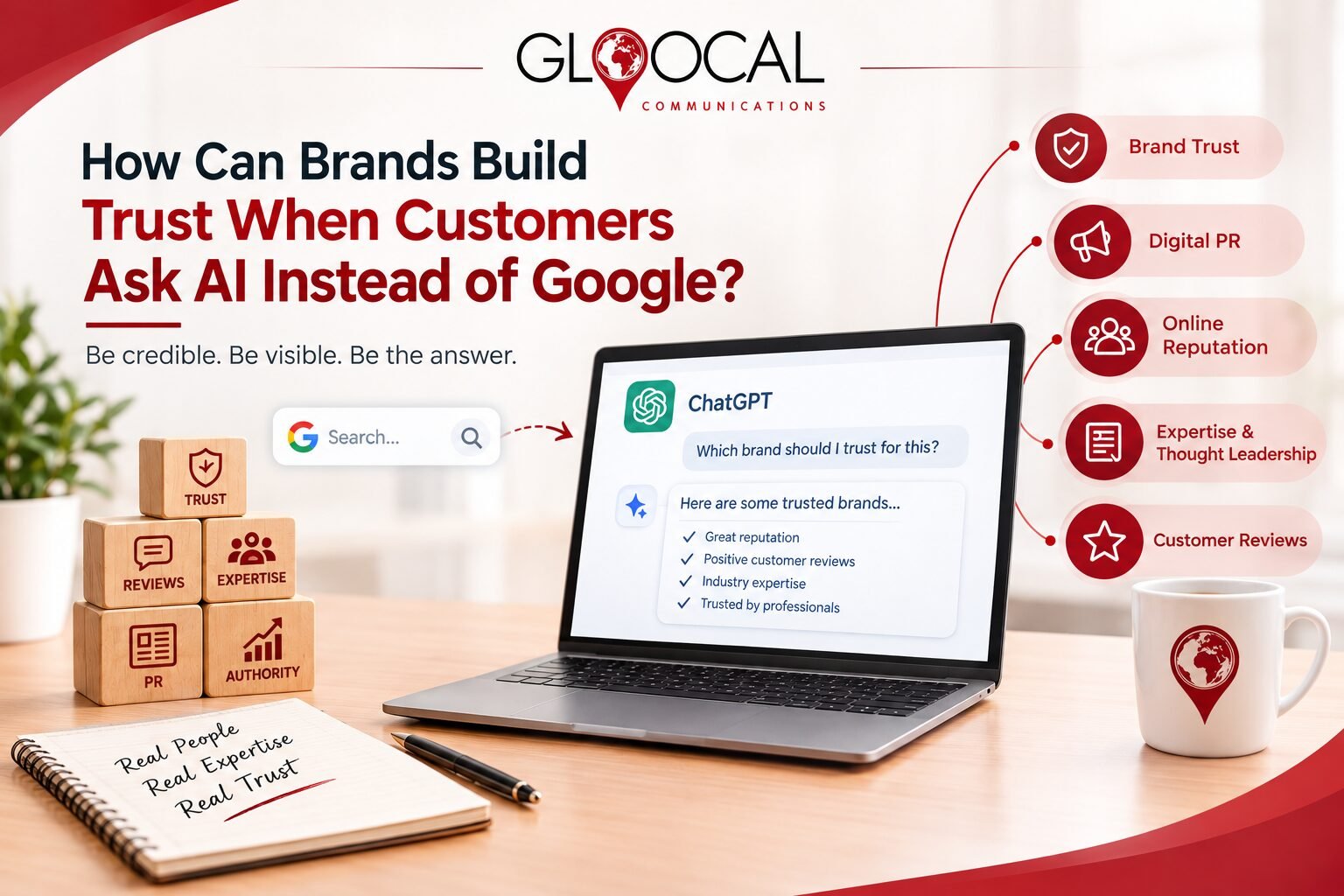
How Can Brands Build Trust When Customers Ask AI Instead of Google?
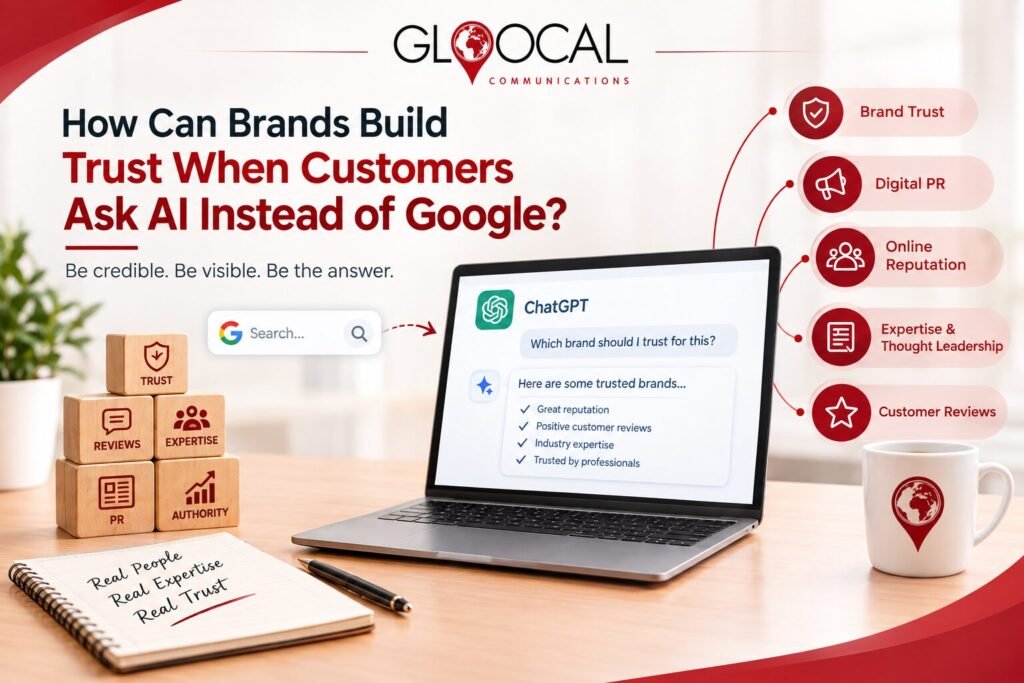
A few years ago, if someone wanted to find a good PR agency, a dentist, or a project management tool, they typed a few words into Google and scrolled through ten blue links. Today, many people simply open ChatGPT or another AI tool and ask, “Who should I trust for this?”
The answer arrives as a neat, conversational summary. No scrolling, no comparing ten tabs. Google itself now places AI-generated summaries above traditional results through AI Overviews. So the real question for every business is this: how can brands build trust when customers ask AI instead of Google?
The short answer is that the fundamentals have not changed, but the stakes around them have. Brand trust in AI search comes from credible information, consistent messaging, genuine expertise, and third-party validation. These are the same things strategic communications and digital PR have always focused on. What is new is that AI tools pull all of these signals together and present a brand to the customer in a single answer.
This guide explains how that works and what you can do about it, without hype and without promises that nobody can honestly make.
Why Brand Trust Matters in the Age of AI Search
When a customer reads ten search results, they form their own opinion. When they read one AI-generated answer, they tend to accept the summary as a starting point. That makes the way your brand is described far more important than it used to be.
Brand trust in AI search is about whether the information available about your business is accurate, consistent, and believable enough for an AI system to represent you fairly. If your website says one thing, your social profiles say another, and a three-year-old news article says something else, the picture gets muddy.
Brand credibility in AI search works on a similar principle. Credibility is built through clear expertise, honest claims, visible people behind the brand, and a track record others are willing to talk about. Consistency, transparency, and reputation sit underneath all of it.
There is also a simple human angle. People who ask an AI tool for a recommendation are usually close to making a decision. If your brand is missing, misrepresented, or described vaguely, you lose that moment without ever knowing it happened.
How Brands Appear in AI Search Results
Let’s be careful here, because this is where a lot of articles overpromise. Nobody outside these platforms knows the full picture of how every AI tool picks its sources, and the systems keep changing.
What we can say sensibly is this. Search-enabled AI systems can draw on a mix of material: your own website, other indexed pages, news coverage, reviews, directories, industry publications, and whatever else is available to them. Some tools rely heavily on their training data, while others pull fresh information from the web when answering.
So how brands appear in AI search depends on the platform, the question being asked, and the sources available at that moment. Ask the same question on two different tools and you may get two different sets of brands.
This is why ChatGPT brand visibility and Google AI Overviews brand visibility are not the same project. Each platform has its own way of selecting and presenting sources. A brand that shows up in one may not show up in another.
What ties them together is the idea of brand mentions in AI search. When reliable, independent sources talk about your brand in a consistent and positive way, it gives AI systems more material to work with. Your own website matters, but what others say about you often carries extra weight.
How to Build Brand Trust Online for AI-Powered Discovery
If you are wondering how to build brand trust online, start with the basics. They are not glamorous, but they do the heavy lifting.
Publish accurate and genuinely helpful content. Write for the real questions your customers ask. Answer them plainly, back up claims with sources, and update pages when things change. Thin, vague content gives neither people nor machines anything worth citing.
Keep your business information consistent. Your company name, services, address, leadership details, and descriptions should match everywhere: website, LinkedIn, Google Business Profile, directories, and press boilerplates. Small mismatches look minor to you, but they make it harder for any system to be sure who you are.
Show your expertise with original thinking. Share perspectives that come from your actual work. A founder’s viewpoint, a practical checklist, or an honest explanation of a hard topic says more than a generic overview that fifty other sites already have.
Take reviews and testimonials seriously. Real customer feedback, handled professionally, is one of the strongest trust signals a brand can have. Respond to praise and criticism alike, and do it in a calm, human voice.
Together, these habits are the foundation of building trust in AI search. None of them is a trick. They simply make your brand easier to understand and easier to believe.
How Digital PR Strengthens Brand Credibility in AI Search
Your own website can say you are great. That is expected. What carries more weight is when someone else says it.
This is where digital PR for brand trust comes in. Credible media coverage, expert commentary in industry publications, quotes in relevant articles, podcast appearances, and thoughtful partnerships all create third-party references to your brand. They show that people outside your company consider you worth mentioning.
Digital PR and AI search are closely linked for exactly this reason. AI tools that look beyond a single website may encounter these external references, and they can help paint a more complete picture of what your brand does and who respects it. No one can promise that a particular article will lead to a particular AI recommendation, but a strong, trustworthy footprint is far better than a thin one.
Good PR for brand credibility is earned, not manufactured. Genuine expertise, newsworthy insight, and honest relationships with journalists and editors create coverage that lasts. Paid placements dressed up as editorial, mass-produced guest posts, or hollow “mentions” might look like a shortcut, but they rarely build real standing, and they can hurt you if they come across as spam.
Think of it as reputation work first and visibility work second. When the reputation is real, visibility tends to follow.
How to Build Brand Authority in AI Search
Many founders ask how to build brand authority without sounding like they are shouting. The answer is to become genuinely useful in a specific area.
Authority comes from depth. Pick the topics where your brand has real experience and cover them thoroughly and consistently. Publish regularly, not in random bursts. Share original research or first-hand observations when you have them, and cite credible sources when you do not.
Brand authority in AI search grows when your name keeps appearing alongside the right topics in the right places. That could be your own articles, an expert quote in an industry publication, a speaking slot at a relevant event, or a mention in a respected newsletter.
Online brand authority is not built in one campaign. It builds slowly, through repeated, reliable signals that your brand knows its subject. If you are focused on building brand authority online, pay attention to recognition within your own industry first. Being known by the right few hundred people often matters more than being vaguely known by thousands.
A practical way to start: list the five questions your ideal customers ask most often, and make sure your brand has the clearest, most trustworthy answers to them, on your own site and, where possible, in other credible places too.
Generative Engine Optimization and Answer Engine Optimization Explained
Two new terms are being thrown around a lot, so let’s define them in plain language.
Generative engine optimization (GEO) is the practice of improving how your brand and content are understood and used by generative AI tools, the ones that write answers rather than just list links. GEO for brands usually means clear, well-structured content, strong entity information, credible external references, and a consistent brand story.
Answer engine optimization (AEO) focuses on being a good source for direct answers, whether that is a featured snippet, a voice assistant reply, or an AI summary. AEO for businesses often involves concise answers to common questions, helpful FAQs, and well-organised pages.
The two overlap heavily. In practice, GEO leans toward how AI systems generate and describe, while AEO leans toward how answers get selected and displayed. Most businesses do not need to treat them as separate projects.
AI search optimization, as a broader idea, sits on top of traditional SEO rather than replacing it. Crawlable pages, good site structure, helpful content, and sound technical health still matter. Think of GEO and AEO as an extension of good SEO that pays more attention to clarity, credibility, and context.
One honest caveat: there is no guaranteed formula. Anyone who promises a fixed method for appearing in AI-generated answers is selling certainty that does not exist.
How to Get Recommended by ChatGPT and Mentioned in AI Search
This is probably the question behind most searches on this topic. How to get recommended by ChatGPT is a fair thing to ask, but the honest answer is that you can improve your chances of being found and described accurately, not force a recommendation.
Here is what tends to help:
- Clear service pages that explain what you do, who you do it for, and where you operate, in plain language.
- Authoritative content that answers real customer questions in depth.
- Consistent brand details across your website, profiles, and directories.
- Useful FAQs written the way people actually ask questions.
- Credible third-party coverage from publications and platforms your audience respects.
If you are asking how to get mentioned in ChatGPT, the same logic applies. A brand that is easy to understand, widely and positively referenced, and clearly connected to a topic gives the system more to work with.
Still, outcomes depend on the platform, the exact question, the sources available at that time, and factors no one outside the platform can fully see. Treat visibility as something you earn and maintain, not something you buy once.
Building an Effective AI Search Marketing Strategy
You cannot improve what you do not watch. A sensible AI search marketing strategy starts with knowing how your brand currently shows up.
To track AI search brand visibility, make a list of the questions your customers are likely to ask, such as “best [service] in [city]” or “how to choose a [type of provider]”. Run these queries on a few AI tools regularly and note which brands appear, how they are described, and which sources seem to be used. Doing this monthly gives you a useful baseline for AI visibility for businesses of any size.
Pay close attention to brand reputation in AI search. If an AI tool describes your services incorrectly, uses outdated information, or leans on an old review, that is a signal to fix the underlying sources, not just to complain about the answer.
The strongest approach combines several disciplines rather than relying on one:
- Traditional SEO for technical health and discoverability
- Content marketing for depth and expertise
- Reputation management for reviews and sentiment
- Digital PR for third-party credibility
This is where an integrated SEO and digital PR strategy earns its keep. SEO makes you findable, PR makes you believable, and the two reinforce each other. A joined-up PR and GEO strategy takes this one step further by making sure the coverage you earn also supports how AI systems understand your brand.
Practical Steps Brands Can Take Today
If you want to get moving this month, here is a simple plan.
- Audit your brand information. Check your website, social profiles, directories, and press mentions for outdated or conflicting details, and fix them.
- Improve key service pages and author credibility. Make every important page clear and specific, and add real author names, roles, and experience.
- Publish helpful, expert-led content. Focus on customer questions, and let people with real knowledge write or review the content.
- Strengthen digital PR. Build genuine relationships with journalists, editors, and industry voices, and share useful insight rather than sales pitches.
- Encourage authentic reviews. Ask happy customers for honest feedback, and reply to every review professionally, including the critical ones.
- Monitor AI-generated mentions. Check what AI tools say about you, and correct inaccurate information at its source where possible.
- Measure what you can. Look at referral traffic, branded search trends, relevant mentions, and AI visibility data where it is available. Be patient, because trust-related results build over time.
Common Mistakes That Undermine Brand Trust in AI Search
Some habits quietly damage the trust you are trying to build.
Publishing thin or repetitive content. Pages written only to hit keywords give readers and AI systems little reason to rely on you.
Buying low-quality links or manufactured mentions. They may look like progress in a report, but they do not create real authority.
Using misleading claims or unverified statistics. One shaky number can weaken everything else on the page. If you cannot source it, leave it out.
Letting business information drift. Different names, addresses, or service descriptions across platforms create confusion.
Treating GEO as a guaranteed shortcut. It is a set of good practices, not a magic switch.
Ignoring customer feedback. Unanswered complaints and neglected reviews hurt your online reputation and brand trust far more than most teams realise.
Frequently Asked Questions
What is brand trust in AI search?
It is the confidence customers and AI systems can place in your brand based on the accuracy, consistency, and credibility of the information available about you. It covers your website, third-party coverage, reviews, and overall reputation.
How can businesses build trust in AI-generated search results?
Publish accurate and helpful content, keep your business details consistent everywhere, earn credible third-party coverage, and manage reviews and reputation carefully. There is no single trick; it is the combined effect of these habits.
How can a brand improve its chances of being recommended by ChatGPT?
Make your services clear, build topical authority, earn mentions from respected sources, and keep your information consistent. These steps improve your chances of being found and described correctly, but no one can guarantee a recommendation.
What is the difference between GEO and AEO?
GEO focuses on how generative AI tools understand and describe your brand, while AEO focuses on being selected as a direct answer in places like snippets, voice assistants, and AI summaries. They overlap and share many of the same best practices.
Does digital PR help improve AI search visibility?
It can help. Credible coverage and expert commentary create third-party references that support your reputation and may give AI systems more reliable material about your brand. It does not guarantee any specific AI mention.
How can businesses monitor brand mentions in AI search?
Make a list of customer-style questions, run them regularly across the AI tools your audience uses, and record which brands appear, how they are described, and which sources are used. Pair this with branded search and referral traffic data.
Why are online reputation and brand authority important for AI discovery?
Because AI-generated answers often summarise what is widely said about a brand. Positive reviews, expert content, and trusted coverage give a clearer and more favourable picture to work from.
Conclusion
So, how can brands build trust when customers ask AI instead of Google? By doing the unglamorous work well: keeping information accurate and consistent, publishing genuinely useful content, earning credible coverage, and looking after online reputation.
Brand trust in AI search is not a trick to be engineered. It is the result of real expertise, shown clearly and backed up by others. Brands that treat AI visibility as an extension of genuine authority, rather than a shortcut, are the ones most likely to be described accurately and fairly when customers ask.
If you would like support with digital PR, brand reputation, SEO, or a joined-up approach to AI search, you are welcome to explore the services offered by Gloocal Communications and see whether they fit your goals.