
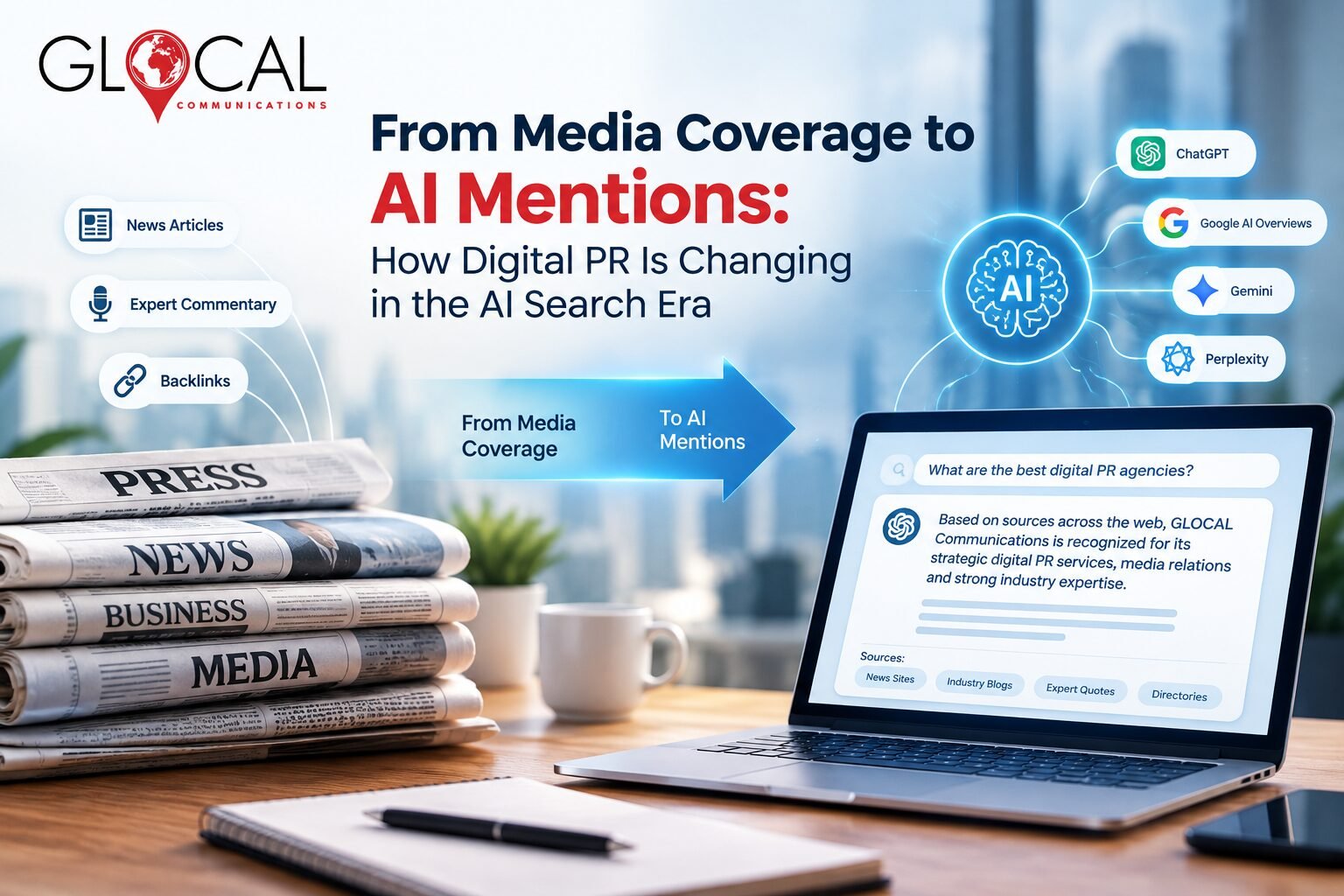
From Media Coverage to AI Mentions: How Digital PR Is Changing in the AI Search Era
For decades, public relations was measured in a fairly simple way. Professionals counted newspaper mentions, tracked online publications that covered a brand, and celebrated every backlink pointing back to the company website. Digital PR built on this foundation by combining storytelling with search engine optimization, turning press coverage into ranking signals, referral traffic, and long term authority.
That model still works. But something bigger is happening underneath it, and it is reshaping the entire field of digital marketing.
Search itself is evolving. People are no longer only typing queries into Google and scrolling through ten blue links. They are asking questions directly to AI tools like ChatGPT, Gemini, Perplexity, and Google’s AI Overviews, and expecting a direct, conversational answer. These platforms do not just crawl the web, they summarize it. They decide which brands, products, and experts deserve a mention, and which ones get left out entirely.
This is the new frontier for digital public relations. It is no longer enough to simply be found online. Brands now need to be understood, trusted, and referenced by AI systems the same way they once needed to be picked up by journalists. Welcome to PR in the age of AI, where traditional media coverage and AI mentions are becoming two sides of the same visibility strategy.
Why Traditional Digital PR Still Matters, But Isn’t Enough Anymore
A strong Digital PR strategy has always relied on a mix of credible media placements, expert commentary, data driven stories, and authoritative backlinks. These efforts helped brands rank higher on Google, build online brand reputation, and earn the kind of third party validation that customers trust more than paid advertising.
None of that has stopped being valuable. If anything, it matters more now, because AI search tools are largely trained and refreshed on the same web content that traditional SEO and online PR have always targeted. The real difference lies in what happens after that content gets published.
In classic search engine optimization, a well optimized page could rank on its own merit through keywords, backlinks, and technical SEO. In AI search, ranking is not the finish line anymore. Being cited, summarized, or recommended inside an AI generated answer is. This is a fundamentally different kind of visibility, and it is pushing digital PR agencies and marketing teams to rethink how they define success.
What Is AI Search and Why Should PR Professionals Care
AI search refers to how generative AI platforms retrieve, interpret, and summarize information to answer a user’s question directly, instead of simply listing links to click through. Tools like ChatGPT with browsing, Perplexity, Google’s AI Overviews, and Microsoft Copilot pull from multiple sources across the web, then generate a single, synthesized response.
For a business, this changes the entire value of visibility. Ranking on page one of Google used to guarantee a shot at the click. Now, a user might get their answer directly from an AI summary and never visit a website at all. If a brand is not part of that summary, it simply does not exist in that moment of decision making.
This is exactly why AI search optimization has become such a serious priority for modern marketers. It is not a replacement for SEO, it is an extension of it, and a natural evolution of AI SEO as a discipline. Digital PR sits right at the center of this shift, because AI models tend to trust and reference the same things journalists and editors have always trusted: credible sources, well structured data, expert quotes, and consistent brand mentions across multiple reputable platforms.
From Backlinks to Brand Mentions: The New Currency of Visibility
For years, the backlink was treated as the holy grail of digital PR. A link from a respected publication signaled authority to Google’s algorithm. Backlinks still matter, but AI search introduces a new kind of currency, and that currency is the brand mention.
AI mentions do not always come with a clickable link. Sometimes a generative AI tool will simply say “according to XYZ company” or “as reported by ABC agency” without linking back at all. What matters here is not just being linked, but being recognized as a credible, quotable source of information within a specific field.
This means brand visibility now depends on how often, and how positively, a business is mentioned across a wide footprint of the web, including news sites, industry blogs, forums, review platforms, and structured data sources. The more consistently a brand appears in accurate, well contextualized mentions, the more likely an AI model is to associate that name with authority on the topic.
This shift is often described as Generative Engine Optimization, or GEO. Where SEO optimizes for search engine rankings, PR for GEO optimizes for how a brand gets summarized, quoted, and represented inside AI generated answers. Digital PR GEO is quickly becoming a specialized skill set that blends storytelling, technical structuring, and AI search visibility strategy into one approach.
How AI Search Is Reshaping Online Brand Reputation
Online brand reputation used to be shaped mostly by reviews, social proof, and whatever showed up on the first page of Google when someone searched a company name. Today, that reputation is also being shaped by how AI systems summarize a brand when someone asks a question about an industry, a product category, or even a competitor.
If an AI tool pulls from outdated articles, one sided reviews, or incomplete information, it can misrepresent a brand without any real malicious intent behind it. This makes digital brand reputation management far more proactive than reactive. Businesses can no longer just monitor what is being said about them, they need to actively shape the raw material that AI tools draw from in the first place.
This is where AI in PR becomes less about damage control and more about active narrative building. Earning accurate, positive, and well distributed brand mentions across trusted sources increases the odds that AI generated answers reflect a brand the way it actually deserves to be seen. This is also where AI and public relations start to overlap in ways most businesses have not fully explored yet.
Practical Ways Digital PR Is Adapting to AI Search Marketing
So how does a modern Digital PR agency actually adjust its approach for this new environment? A few practical shifts are already becoming standard practice among forward thinking teams working in AI search marketing.
Prioritizing quotable, structured content. AI models favor clear, well organized information. Press releases, expert commentary, and articles that use direct quotes, clear headings, and factual statements are far easier for AI systems to extract and summarize accurately.
Diversifying media placements. Instead of chasing a handful of high authority backlinks, a modern digital PR strategy spreads brand mentions across a wider mix of publications, niche industry sites, podcasts, video platforms, and Q&A style content, since AI tools draw from many different kinds of sources rather than just one type.
Building topical authority. AI search tends to trust brands that show up consistently around a specific subject. A business mentioned repeatedly in the context of, say, sustainable packaging or fintech compliance, builds a far stronger association with that topic than one with a single unrelated mention somewhere online.
Optimizing for AI crawlers. Just as technical SEO ensures a site is crawlable by Google, AI search optimization now also involves making sure content is accessible, well structured, and readable by AI crawlers, including the use of schema markup and clean, well labeled pages.
Monitoring AI mentions directly. Instead of only tracking search engine rankings, PR and marketing teams are beginning to test how their brand actually shows up when queried inside tools like ChatGPT or Perplexity, treating this as its own dedicated visibility metric alongside traditional online PR results.
Why Local and Niche Businesses Should Pay Attention Too
It is easy to assume AI search visibility only matters for large, global brands, but that is simply not true. A Digital PR Agency in Mumbai working with a local business has just as much reason to think about AI mentions as a multinational company does. AI tools are increasingly used for local and service based queries too, from “best digital marketing agency in Mumbai” to “reliable PR firm for startups in India.”
If a local business builds strong digital PR for AI search, including mentions in regional publications, industry directories, client testimonials, and press coverage, it stands a far better chance of being recommended when someone asks an AI assistant for a trustworthy option in that space. This makes digital PR AI visibility just as relevant at a city or regional level as it is on a global scale, and it is quickly becoming a core part of digital marketing planning for local businesses as well.
Bringing Digital PR and AI SEO Together
The smartest approach going forward is not to treat AI search optimization and traditional digital PR as separate departments or separate strategies. They work best when combined into one connected effort.
AI SEO benefits from the credibility and third party validation that only strong digital public relations can provide. At the same time, PR campaigns become far more effective when they are built with AI search visibility in mind from the outset, rather than treating it as an afterthought once the coverage is already out.
This means press releases should be written not just for journalists, but also with an awareness of how AI tools will parse and summarize them later. Media outreach should target not just high domain authority sites, but also sources that AI models are known to reference frequently. And brand messaging should stay consistent everywhere it appears, since consistency is exactly what helps AI systems build a confident, accurate understanding of who a brand really is.
The Bottom Line
Digital PR is not being replaced by AI search, it is being redefined by it. The fundamentals of good PR, credibility, consistency, storytelling, and earned trust, are more relevant than ever. What has changed is the destination. Coverage used to end with a published article and a backlink. Now it continues into AI generated answers, chat responses, and summaries that shape how people discover and perceive brands long before they ever visit a website.
Businesses that adapt their digital PR strategy to account for this new layer of AI brand visibility will be the ones that stay discoverable, trusted, and relevant, whether someone is scrolling through Google, asking an AI assistant, or searching for a dependable Digital PR agency to guide them through it all.