

June 23, 2026
If you are researching a scuba replacement package for your commercial diving team and still not sure whether a 2 diver or 3 diver configuration is the right call, this guide is written for you. At JK Subsea Engineering, we build and supply SRP diving equipment across India and talk to project managers and dive supervisors every week who are working through exactly this question. The answer depends on your project scope, dive classification, and IMCA D040 compliance requirements, not just how many people you have on the boat.
A scuba replacement package replaces the diver’s back-mounted tanks with a continuous air supply delivered from the surface through an umbilical. The diver is connected to a diver air panel on deck, which controls breathing air pressure, monitors depth via a pneumofathometer gauge, and keeps the supervisor in contact with the diver at all times.
This surface supply diving system approach is used in professional commercial diving because it removes the bottom time restriction of a scuba cylinder, gives the supervisor direct control of the air supply, and satisfies the safety requirements that most offshore and subsea contracts now demand.
The configuration you choose, 2 diver or 3 diver, affects how many divers you can support simultaneously, how your gas supply is structured, how many breathing air cylinders for diving you need on the frame, and whether you meet IMCA D040 diving equipment requirements for your specific operation.
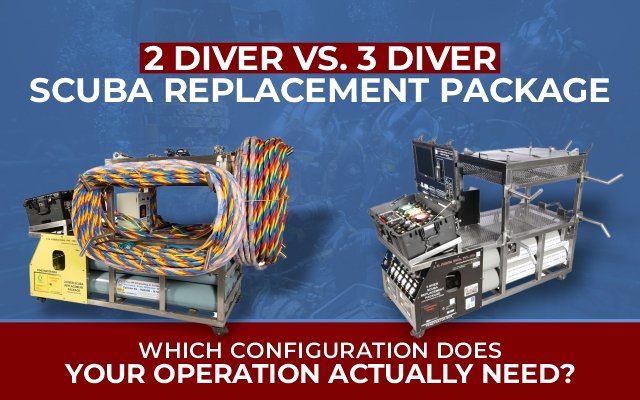
A standard 2 diver scuba replacement package is built around a stainless steel frame housing four 50 litre breathing air cylinders, connected through an air management panel to a two diver air panel placed in a Pelican case. Each diver has independent HP and LP supply lines with crossover capability between Diver 1 and Diver 2. The system runs on 220V AC or 12V DC and can be deployed quickly from a small vessel or quayside.
Typical components in a 2 diver SRP:
In practice, a 2 diver package puts one diver in the water and one standby diver kitted up and ready to respond. This satisfies the fundamental commercial diving safety rule: a standby diver must be available to enter the water immediately whenever a diver is in the water
A 2 diver SRP is the right choice for:
For commercial diving contractors operating under ONGC, port authority, or Indian Navy contracts at moderate risk levels, the 2 diver package is the standard workhorse. It is a portable diving support system that can be loaded on a pickup, mobilised to a small work boat, and operational within a couple of hours.
A 3 diver scuba replacement package scales up the frame, the cylinder count, and the panel to support three independent divers. The frame houses six 50 litre breathing air cylinders, and the three diver air panel adds a full third set of HP and LP lines, pneumo gauges, and communications for Diver 3, with crossover capability across all three positions.
Typical components in a 3 diver SRP:
The three-diver panel is what makes the real operational difference. You can have a working diver in the water, a standby diver in the water for complex confined space tasks, and a third position ready for the next rotation or for emergencies, all managed from the same topside panel simultaneously.
A 3 diver SRP is required or strongly recommended for:
As an offshore diving equipment manufacturer in India, we supply the 3 diver configuration primarily for oil and gas field work in Indian waters, subsea pipeline inspection, and marine construction projects where the dive supervisor has no option but to meet IMCA D040 requirements before the diving management system will be approved.
IMCA D040 is the International Marine Contractors Association’s guidance for mobile and portable surface supply diving systems. It is the benchmark document referenced in most offshore diving contracts, and it directly affects which SRP configuration you need.
The two points that matter most for the 2 vs 3 diver decision:
Standby diver requirement. IMCA D040 requires that a standby diver be available to enter the water immediately. In a 2 diver operation, this is the second position on your panel. In higher-risk operations, where a standby diver must actually be in the water at a particular depth ready to assist, a third diver position is needed topside for supervision and gas management.
Gas supply redundancy. For operations classified as higher risk under D040, additional breathing air supply redundancy is required. The 3 diver SRP with 6 cylinders and a full three-channel panel provides this redundancy built in. Adding cylinders to a 2 diver system after the fact is a common workaround but creates certification and documentation complications.
If your project requires an IMCA-compliant diving management system, get the compliance requirement confirmed in writing before you decide on your SRP configuration. Arriving on a project with a 2 diver system when the DMS requires three positions will shut the job down.
Both 2 diver and 3 diver scuba replacement packages are available with either steel or composite (carbon fibre) breathing air cylinders for diving. This choice matters for weight and mobilisation.
Steel cylinders are heavier but more robust. They are the standard choice for offshore operations where the frame will be crane-lifted and weight is not the primary concern. Steel cylinder frames are also typically lower cost.
Composite cylinders are significantly lighter. The same 50 litre capacity in a composite cylinder weighs far less than its steel equivalent. For operations where deck space is tight, where the system needs to go on a small vessel with limited crane capacity, or where frequent road transport is involved, composite cylinders reduce handling difficulty and transport cost.
At JK Subsea Engineering, we build both configurations to order. If your team is doing nearshore work with regular mobilisation by road, composite cylinders in a 2 diver frame is often the practical answer.
Work through these questions before finalising your SRP procurement:
JK Subsea Engineering is a commercial diving equipment manufacturer based in Mumbai, India. We build 2 diver and 3 diver scuba replacement packages for the Indian market and for export, and we understand the specific operational conditions that Indian diving contractors work in.
Indian offshore diving projects, particularly those in the Mumbai High, Krishna Godavari basin, and along the eastern and western coast, have their own combination of weather windows, vessel constraints, and client audit requirements. Our systems are built to handle real working conditions in these environments, not just meet a specification on paper.
We supply complete SRP packages as well as individual components including replacement diver umbilicals, panel repairs, breathing air cylinder testing and refilling, and certification support for IMCA and client submissions.
If you are comparing options and want a straight conversation about which configuration fits your next project, contact our team directly.
| Feature | 2 Diver SRP | 3 Diver SRP |
|---|---|---|
| Breathing Air Cylinders | 4 × 50 litre | 6 × 50 litre |
| Diver Air Panel Positions | 2 | 3 |
| Umbilicals | 2 × 4 Core | 3 × 4 Core |
| Typical Use | Nearshore, inspection, light maintenance | Offshore, confined space, high-risk operations |
| IMCA D040 Compliance | Yes | Yes |
| Frame Weight | Lighter | Heavier |
| Cost | Lower | Higher |
JK Subsea Engineering Pvt. Ltd. is a Mumbai-based offshore diving equipment manufacturer in India supplying commercial diving equipment across India and internationally. Our product range includes 2 diver and 3 diver scuba replacement packages, surface supply diving systems, diver air panels, breathing air cylinder diving systems, and portable diving support systems built to IMCA D040 standards.
Fill in your details below to instantly download the product datasheet.