


June 26, 2026
If you are sourcing surface supply equipment for a commercial diving project in India, the diver air panel is the one piece of topside kit that needs the most attention before you place an order. Every litre of breathing gas going to a diver passes through it. The project documentation you need for ONGC contracts or vessel owner audits all starts with whether this panel is correctly built and certified.
This guide covers what a diver air panel is, how each component works, what IMCA D040 or D023 requires, the difference between a 2 diver air panel IMCA and a 3 diver air panel IMCA configuration, and what to check when buying from a diver air panel manufacturer in India.
A diver air panel is the topside control unit that manages the supply of breathing gas from the surface to one or more divers working underwater. It connects between the air source, either a low pressure compressor or high pressure cylinders, and the diver’s umbilical. The supervisor uses it to regulate pressure, monitor depth, manage backup supplies, and switch between primary and emergency gas without interrupting the diver’s breathing.
In surface supplied diving, the diver carries no air on their back. Gas comes from the surface through an umbilical. The diving supervisor control panel is where the supervisor runs the entire dive. Depth checks, pressure monitoring, emergency gas switching, and diver communications all happen at this panel.
A portable diver air panel for offshore and commercial operations is typically housed in a heavy-duty Pelican case. This lets it deploy quickly across different vessels, platforms, and field locations without any fixed installation work.
Understanding each part of a commercial diving control panel helps you ask the right questions when comparing products and suppliers.
The diving panel system starts at the high pressure inlets. Breathing air cylinders at 200 or 300 bar connect here. Each diver position on a correctly built IMCA D040 air panel has at least two independent HP supply lines, HP1 and HP2. If HP1 runs low or fails, the supervisor switches to HP2 with no interruption to the diver.
HP regulators inside the panel step down cylinder pressure to the lower working pressure suitable for delivery through the umbilical.
Most offshore diving air panel setups run a low pressure compressor as the primary air source, with HP cylinders as Backup. The LP inlet connects directly to compressor output. This is the preferred configuration for longer dives because the compressor provides a continuous supply while the cylinders hold a finite emergency reserve.
On a properly configured panel, the supervisor can switch from LP to HP in seconds. The diver never notices.
The pneumo gauge is how the supervisor reads diver depth in real time. A small bore pneumo hose runs from the panel through the umbilical core to the diver. When the supervisor opens the pneumo valve briefly, a short burst of air clears water from the hose. The resulting back-pressure on the gauge converts directly to depth.
This reading is independent of any gauge the diver carries, making it a cross-check rather than a single point of failure. On an IMCA D040 and D023 compliant panel, each diver position has its own dedicated pneumo gauge and line. Standard range for offshore diving equipment in India’s air diving depth window is 0 to 70 MSW (0 to 230 FSW).
A crossover valve connects one diver’s supply circuit to another. If Diver 1’s primary line fails, the supervisor opens the crossover and draws air from the Diver 2 circuit as an emergency measure while the diver comes up. This is a mandatory safety feature on any IMCA D040, D023 air panel and cannot be removed or omitted on offshore projects.
A properly built diver air control panel includes an integrated diver radio. For a 2 diver air panel IMCA configuration this is typically an Amron two-diver unit. For a 3 diver air panel IMCA configuration it handles three channels simultaneously. The supervisor talks to each diver and monitors all channels from the same panel.
Some panels also carry optional diver CCTV, with individual monitors for each diver’s helmet camera installed at a downward angle so the supervisor can watch the screen without neck strain during long operations.
Each diver supply manifold includes pressure relief valves that vent automatically if supply pressure goes above the safe limit. Low pressure alarms alert the supervisor if a diver’s supply pressure drops below the set threshold, giving time to switch to backup before the diver is affected.
This is the part most product pages skip, but it matters when you are evaluating panel layout and usability.
Before the dive, the supervisor checks all HP cylinder pressures, confirms the LP compressor is running and delivering correct pressure, tests pneumo gauge accuracy against a known depth reference, and runs communications checks with both the working diver and the standby diver.
During the dive, the supervisor watches the pneumo gauge to track depth, calls depth checks on the radio every few minutes, monitors HP and LP supply pressures continuously, and logs the dive profile for the decompression table calculation. If the compressor shows any sign of pressure drop, the supervisor opens the HP backup valve before the diver’s supply is affected.
At depth changes, the supervisor adjusts LP regulator output to match the diver’s new ambient pressure requirement. If the working diver signals an equipment problem, the supervisor has the crossover valve and the emergency HP supply ready.
After the diver surfaces, the supervisor logs all pressures, depth and time data, and supervises the post-dive decompression obligation if applicable.
A panel with a confusing layout or small gauges slows all of this down. This is why gauge size, valve positioning, and label clarity matter as much as the underlying specification.
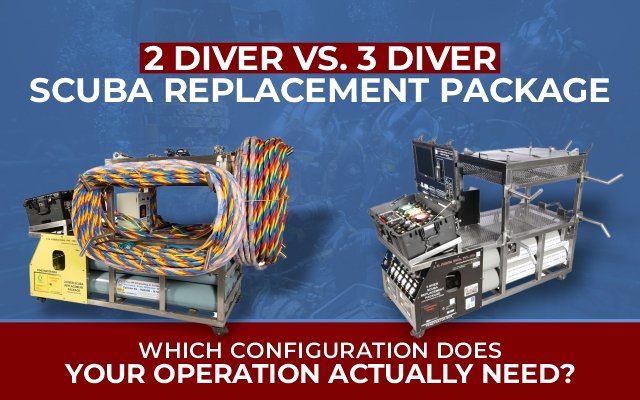
A 2 diver air panel IMCA D040 & D023 compliant panel manages one working diver and one standby diver simultaneously. Each position has independent HP supply lines, its own pneumo gauge, LP connection, crossover capability, and a communications channel. The supervisor manages both from the same panel.
This is the standard configuration for nearshore, port, harbour, ship hull, and civil infrastructure inspection work in India. It fits in a standard Pelican case and can set up on a small workboat within an hour.
A portable diver air panel in the 2 diver configuration is the right choice when your project risk level does not require a third diver in the water and your client specification does not call for three positions.
A 3 diver air panel IMCA D040 & D023 compliant panel adds a full third diver position with its own supply lines, pneumo gauge, regulators, and communications channel. Crossover valves connect all two diver and kept 3 diver independent.
This is the required configuration for most offshore diving operations in Indian waters. ONGC offshore contracts, subsea pipeline inspection, marine construction, and projects with international client audits almost always specify a three-position panel. A 3 diver air panel IMCA is also used when dive rotation plans require three active umbilical connections simultaneously.
The panel is physically larger than the 2 diver equivalent but still housed in a Pelican case for field portability. For offshore diving equipment in Mumbai and across India’s oil and gas coastal projects, this is the more commonly specified configuration.
A standard diver air panel handles breathing air only, approximately 21% oxygen and 79% nitrogen, and is certified for air diving operations within the standard depth limit.
A mixed gas diving panel is built for operations using gas blends other than standard air. This includes nitrox for shallower dives with reduced decompression obligations, and trimix or heliox for deep work where helium replaces nitrogen to manage narcosis and oxygen toxicity.
Mixed gas diving panels include gas analyser ports, flow meters for each gas line, and oxygen-compatible stainless steel system components. They are a different equipment category with higher costs and additional certification requirements under IMCA D037 and IMCA D048 for nitrox operations.
For most commercial diving projects in India at depths within the air diving range, a standard IMCA D040 air panel is sufficient. If your scope involves work beyond 50 metres or specific gas mix requirements, confirm with your diving management system whether a mixed gas diving panel is specified before purchasing.
IMCA D040 covers the design and use of mobile and portable surface supplied diving equipment systems. It sets out the required safety architecture: independent gas supplies per diver, crossover provisions, correct gauge ranges, pressure relief protection, and communications integration.
IMCA D018 governs the testing, inspection, and ongoing certification of diving plant and equipment. A panel delivered with an IMCA D018 compliant certification package from Bureau Veritas or a recognised class society gives the project manager the paperwork an offshore client will ask for at the equipment audit.
When buying from any diver air panel manufacturer in India, ask for three documents before committing:
A supplier who cannot produce all three should not be on your shortlist for offshore work.
A portable diver air panel in a Pelican case is the standard choice for offshore diving field operations. The case provides IP-rated environmental protection, makes the panel easy to transport between vessels and locations, and eliminates any fixed installation requirement. Most offshore diving air panel supplier products available for Indian operations are in this format.
Wall mount panels are for fixed diving facilities such as dive schools, onshore training bases, and vessels with a permanent dive station. They offer cleaner cable management but cannot move between job sites.
For commercial diving contractors working across multiple projects and locations in India, the portable Pelican case format is almost always the right choice.
Diver air panel price varies based on several factors. Knowing what drives cost helps procurement managers compare quotes accurately rather than buying on headline price alone.
For project-specific pricing, contact the JK Subsea team directly with your configuration, depth rating, and certification requirements.
Before finalising a purchase from any offshore diving equipment in Mumbai supplier or diver air panel manufacturer in India, go through this list:
Sourcing a diver air panel from a diver air panel manufacturer in India saves time, reduces project risk, and cuts total cost compared to importing from overseas suppliers. A Mumbai-based manufacturer delivers faster, supports local certification, and responds to scope changes without the delays that come with international supply chains.
Contact the JK Subsea team in Mumbai for a project-specific quote.
Most offshore diving equipment used in India today is either imported from UK or the US, or sourced from a small number of Indian manufacturers and suppliers. Working with an Indian supplier has straightforward advantages: shorter lead times, no customs delays, easier access to spares, and support teams who understand the practical realities of Indian offshore operations.
J.K. Subsea Engineering Pvt Ltd manufactures and supplies certified commercial diving equipment for offshore operations in India. Their range covers decompression chambers, diver air panels, LARS systems, hydraulic power packs, umbilicals, and complete diving spread packages, all built to IMCA standards with full certification documentation.
If you are planning an offshore mobilisation or procuring equipment for a new diving spread, contact J.K. Subsea Engineering with your project specifications and they will advise on the right equipment configuration for your operation.
JK Subsea Engineering Pvt. Ltd. is a diver air panel manufacturer in India based in Mumbai. The company supplies portable diver air panels, 2 diver air panel IMCA and 3 diver air panel IMCA D040 certified systems, mixed gas diving panels, and complete surface supplied diving equipment packages for offshore diving operations across India and international markets. Reach the team via the contact page for specifications, lead times, and project-specific recommendations.

Fill in your details below to instantly download the product datasheet.